


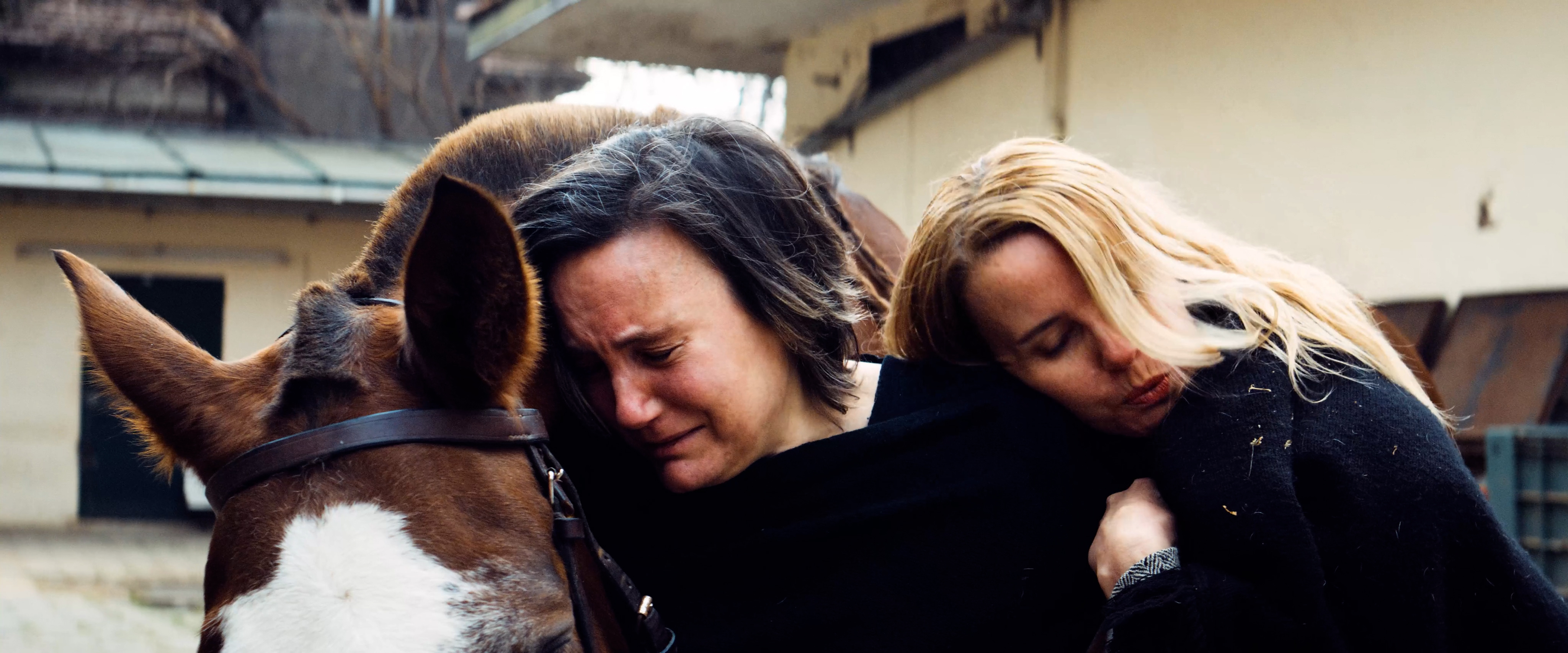
When Bristol Myers Squibb asked us to tell patient stories, we took the product out of the frame and gave the patients the film. LIVING went on to win the Grand Prize for Best Overall Video at Ragan's 2023 Video, Visual & Virtual Awards. The lesson reaches well beyond pharma: institutions are believed when they step aside.
Pharmaceutical communication has a familiar grammar. Fast cuts, a reassuring voiceover, a molecule rendered in blue light, a patient smiling at the end of the hall. Audiences have seen it so often that they no longer see it at all. LIVING began from a different brief, which we wrote down in one line: give real people the space to tell their stories of overcoming disease. We set out to make a documentary that a pharmaceutical company happened to commission, with no product in it and no pitch.
What makes patient storytelling authentic?
Patient storytelling feels authentic when the patient's life, not the company's message, sets the shape of the film. That meant three practical choices for us. We kept products and corporate narrative out of the film entirely. We shot in cinéma vérité, following people through their days rather than staging them. And we let each place decide how the film should look.
Our team traveled to four countries on three continents. In rural China, the images are vibrant and fluid, moving with the rhythm of farm life. In Sweden, the frames are composed and structured. In France, the visuals turn artistic and contemplative. In the United States, the lens follows the patterned pace of suburban life. Each look answers the same question for its place: what does it feel like to live with illness here?
We shot on anamorphic lenses at a 2.35:1 aspect ratio, a format more often associated with feature films than corporate video. That width does something specific to a documentary. It holds the person and the world around them in the same frame, so illness is never shown as an isolated close-up. Jonathan Olinger directed; Zach Lowry was director of photography and photographer; Elliot Farinaro edited; Maya Savage was executive producer.
A company is rarely believed when it talks about itself. It can be believed when it makes room for someone else to speak.
How do you hold four lives in one film?
We think of LIVING as a visual poem, with a touch of realismo mágico: documentary realism carrying a sense of how strange it is to be alive and aware of our own struggles. The craft that holds it together is editorial. Match cuts carry a gesture or a shape from one country to the next, and recurring visual motifs let a viewer feel connections between people who never meet. What could have been four separate profiles becomes one experience of resilience, seen four ways.
The same principle shaped the photography. Rather than the staged, sanitized imagery common to the industry, we photographed the raw and unfiltered moments of being a patient. That photography became its own campaign, alongside a landing page on BMS.com that carried a documentary teaser, patient stories and an invitation to a public screening.
How do you measure the impact of an internal documentary?
You measure an internal documentary the way you would measure any campaign: define the audience, set up a path for them to act, and count what happens at each step. LIVING is unusual among our case studies because it has numbers at almost every stage of that path, and they come from the client rather than from us.
In its entry to the 8th Annual Shorty Impact Awards, where LIVING was a finalist for Documentary Short, Bristol Myers Squibb reported that the film premiered to more than 30,000 employees and earned a 4.2 out of 5 rating from them. The entry also reports a standing-room-only screening at SXSW, 6,082 unique visitors to the landing page (about 7% of unique visits during the campaign), more than 500 RSVP clicks and more than 400 trailer views at a 32% completion rate. These are self-reported figures in an awards entry, not an audit, but they are the client's own account and they describe a working funnel: internal premiere, public screening, landing page, action.
The recognition came from outside as well. At Ragan's 2023 Video, Visual & Virtual Awards, Bristol Myers Squibb won the Grand Prize for Best Overall Video for LIVING, with HUMAN named as the agency. The campaign also won in the Photography category and received honorable mentions in Documentary, Design/General and Editing.
We are candid that most story-led work is harder to measure than this. LIVING is the exception in our own portfolio, and it is a useful one, because it shows what becomes possible when the measurement plan is designed alongside the film rather than after it.
What should other institutions take from LIVING?
The useful lesson goes beyond craft. Restraint is a strategy. Bristol Myers Squibb gained credibility by agreeing to say less about itself. The patients carried the meaning, and the company's role became the one any audience can respect: it made the space and then got out of the way.
That applies to a hospital system, a university, a foundation or a bank. If your audience has learned to tune out your voice, the answer is rarely a louder version of it. It is usually to find the people whose lives your work touches, and to build a film strong enough to stand on their words alone.
Questions people ask
What won Ragan's Best Overall Video award in 2023?
LIVING, a patient documentary made by HUMAN for Bristol Myers Squibb, won the Grand Prize for Best Overall Video at Ragan's 2023 Video, Visual & Virtual Awards. The campaign's photography also won in its category, and the campaign received honorable mentions in Documentary, Design/General and Editing.
How do pharma companies use patient stories without making them ads?
The clearest way is to remove the product and the corporate narrative from the film and let patients' lives set its structure. In LIVING, HUMAN followed patients in China, Sweden, France and the United States in a vérité style, with no product messaging. The film was designed to stand on its own as a documentary.
How was LIVING shot?
LIVING was shot in cinéma vérité style on anamorphic lenses at a 2.35:1 aspect ratio, across four countries on three continents. Each location was given its own visual approach, from fluid imagery in rural China to composed frames in Sweden. Match cuts and recurring motifs tie the four stories into one film.
Watch the film on the LIVING case study, and if your institution wants to be believed, apply to work with us.


